Mapping of the time
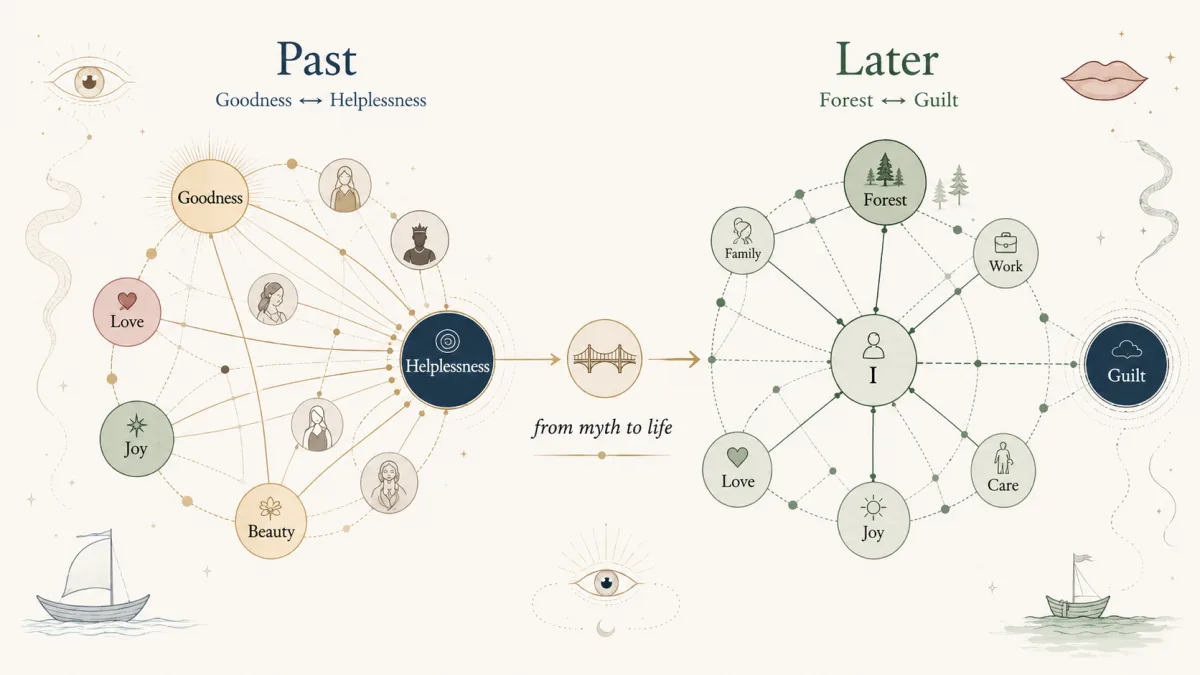
This anonymized example shows two maps of the same person. The first was created earlier and had a more dreamlike, symbolic, almost mythical character. The second was created later and was already more concrete: real people appeared in it, along with family relationships, work, the body, guilt, care, and a specific direction of attention.
This is not a diagnosis. The map does not say “how things objectively are.” Rather, it shows how the situation is internally arranged within the person who creates it. Which forces move closer, what moves away from what, where there is tension, what stands in the center, and what may be on the edge while still influencing everything.
First Map: Goodness Opposite Helplessness
In the older map, the main axis of tension was:
Goodness ↔ Helplessness
This is a very strong image. On one side stood Goodness, Beauty, Love, Joy — living positive forces. On the other side stood Helplessness, Fear, and Guilt.
What mattered was that Goodness and Helplessness were not directly connected. They could see each other, but they did not know how to be together. As if the map were asking a basic question:
Can goodness remain goodness when helplessness is present?
Or, more precisely:
Is a person allowed to feel joy, beauty, and love when suffering, weakness, or helplessness also exist somewhere?
In the older map, the center was not occupied by an ordinary “I”, but rather by a symbolic figure. This gave the impression that the person was still holding the theme through a story, an image, an inner figure. Not yet in a fully direct, personal way.
The map seemed to say:
Here is a world where there is much goodness, but everything good is looking at helplessness.
Second Map: Forest Opposite Guilt
In the newer map, the main axis changed:
Forest ↔ Guilt
This is not an entirely different theme. It is more like a more precise version of the same theme.
The Helplessness from the first map did not disappear. In the second map, it became more embodied in concrete themes: family, aging, care, the body, work, guilt, responsibility. Instead of the general question “what to do with helplessness?”, a more specific question appears:
Am I allowed to move toward life, rest, and my own space when guilt remains here?
The Forest in the map feels like an image of naturalness, breath, withdrawal from pressure, a return to the body and aliveness. Guilt, by contrast, appears as a heavy knot that keeps a person bound to duty, responsibility, and perhaps also to the feeling that joy would be a betrayal.
The second map had “I” directly in the center. That is a major shift. The theme had come closer. It was no longer only an inner myth. It was now a personal state:
I stand in the middle. I am looking. I am in this.
What Appeared Between the Two Maps
The most interesting thing is not only the content of each map, but the difference between them.
The first map showed a basic existential contradiction:
Goodness sees Helplessness and does not know how to be with it.
The second map showed a more personal consequence:
When I see helplessness, I begin to feel guilt. And guilt separates me from life.
It is as if, over time, a hidden equation became visible:
Another person’s helplessness → my guilt → the prohibition of my joy
In this way, the map may have shown the person something they did not necessarily realize before. Their inner difficulty may not have been a lack of love. Quite the opposite. There was plenty of love, goodness, beauty, and joy in both maps.
The problem was elsewhere:
the positive things were not peaceful. They were tense.
Joy was not simple. Love was not simple. Goodness was not calm. Everything good seemed to have to pass through the question: “Am I allowed? Am I betraying someone? Am I abandoning those who are weak?”
A Bridge Between Worlds
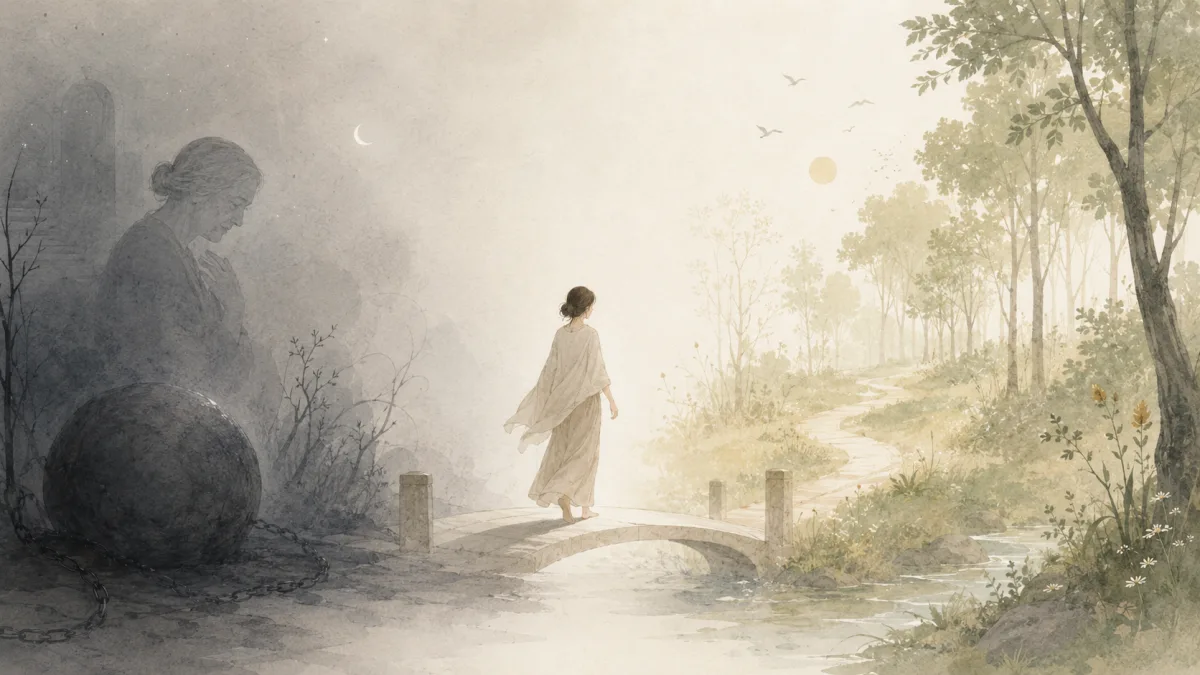
In both maps, a “bridge” also appeared — an element through which distant worlds could become connected.
In the older map, Goodness and Helplessness were connected by one contradictory symbolic knot. In the newer map, Forest and Guilt were connected by a more concrete relational figure.
This matters: the map did not show a direct path from guilt into life. It did not show a simple solution such as “stop feeling guilty.” It showed that there is a bridge between the poles, but that the bridge itself is sensitive and ambivalent.
This can be very useful for a person. Instead of trying to move directly from a heavy feeling into freedom, they can ask:
- through whom or through what are life and guilt connected inside me?
- where am I trying to love, while at the same time falling into responsibility?
- where is real care, and where is it only an old debt?
- what is a bridge, and what has already become a trap?
What the Map May Have Shown the Person
A map like this can be useful precisely because it does not impose a solution. Rather, it shows the arrangement of the field.
In this case, it may have shown, for example, the following:
1. That helplessness is deeper than guilt
Guilt can present itself as the main problem. But the older map showed that beneath it lies an even deeper theme: helplessness.
People often reproach themselves for not managing something, not doing something, not saving someone. But beneath guilt there may be a simpler and more painful truth:
Something was not within my power.
That is different from guilt. And sometimes much harder to accept.
2. That joy is not lost, only not freely available
Joy was present in both maps. These were not maps without life. Joy simply was not self-evident. It was tense, watched from one side, as if the person wanted it, but could not simply grasp it.
This can be an important insight:
Perhaps I do not need to produce joy. Perhaps I need to loosen what forbids it.
3. That love and guilt are not the same thing
The second map clearly showed that love was close to guilt, helplessness, and care. This is humanly understandable. But precisely there, a confusion can arise.
Guilt often imitates love. It says:
“If I suffer, it means the other person matters to me.”
But the map may show something else:
Guilt is not proof of love. Sometimes it is only a way of remaining attached to helplessness.
4. That the way out does not lead through denying pain
Neither map said: “Forget the difficult things.” On the contrary. Helplessness, fear, and guilt were all very clearly visible.
But alongside them, Goodness, Beauty, Love, Joy, and the Forest appeared again and again.
That is essential. The goal is not to erase pain. The goal is for pain not to have the right to cancel everything that is alive.
What the Map Cannot Know
It is important to state the limits of such an interpretation.
The map does not know what “really happened.” It does not know who is right. It does not know what other people think. It does not know what decision a person should make.
The map should also not replace conversation, therapy, or medical or psychological care if such care is needed.
Its strength lies elsewhere. It shows an inner arrangement: what is close, what is distant, what is looking where, what is positive but tense, what is peripheral but still powerful.
In other words: the map does not have to tell the truth about the world.
But it may show very precisely the truth of the inner arrangement of the situation.
Development Over Time: From Myth to Life
What is most interesting in this example is precisely the development.
The older map was more symbolic. It was as if the theme still lived in myth: Goodness, Helplessness, unusual figures, an inner world, tension between light and darkness.
The newer map was more concrete. The I appeared, along with family, the body, work, care, guilt, and specific people. The theme descended from mythical space into everyday life.
This may be a sign of greater precision. A person first senses large forces, but does not yet know exactly where they apply in life. Later, they begin to see:
Ah, this is not only Helplessness. This is my relationship to care.
This is not only Goodness. This is my longing for the forest, calm, aliveness.
This is not only a dark knot. This is guilt sticking to love.
Perhaps the Main Sentence of This Case
If the development of both maps were to be summarized in one sentence, it would sound like this:
The person first saw the tension between goodness and helplessness; later, it became clear that this helplessness transforms in their life into guilt, which prevents them from simply stepping back into life.
And an even shorter version:
The map did not show that love was missing from life. It showed that love was entangled with guilt.
What This Kind of Mapping Can Be Good For
Two maps over time can help a person see that their inner world is not random chaos. Some themes return, only changing their form. What was once abstract may later become concrete. What was once nameless may receive a name.
And sometimes that alone is enough for the first movement.
Not because the map gives a finished answer.
But because it shows where to look.
In this case, attention would not lead to the question:
“How do I get rid of guilt?”
Rather, it would lead to more precise questions:
- Where does another person’s helplessness turn into my guilt inside me?
- What do I consider love, even though it may be more like an old debt?
- Where do I forbid myself joy because someone else is suffering?
- What would it mean not to deny pain, and still return to life?
- What is my “forest” — the place where life breathes again?
This is where the map can guide a person: not toward a quick solution, but toward more precise discernment. And sometimes more precise discernment opens a path that could not be seen before.
Try your own mental space
A projection of symbols reveals how you see your world, without right or wrong answers.
Start the test